


Global Markets - Latest Developments

The satellite sector is undergoing rapid transformation, driven by technological innovation, emerging services, and new spectrum demands. Yet, as the industry evolves, so too must the regulatory frameworks that govern it. Regulations are constantly shifting, licensing models are becoming more adaptive, and procedures increasingly open and interactive. In this environment, National Consultations have become essential forums for shaping regulation — and a strategic opportunity for operators to participate and stay ahead of the curve.

The Cloud Chamber is that school experiment where you observe the path of charged particles, like cosmic rays and electrons, through a supersaturated gas. This is a metaphor for tracking our industry situation; however, that trace only shows where the particle has been. The Cloud Chamber is like tracking in the open to see things that deviate from normal. Alternatively, what’s there and what isn’t?

The European Commission has proposed ambitious new measures to make Europe's space sector cleaner, safer and more competitive.

Having spent most of my adult life in Greater China, South Korea has always been on the periphery: a place that I know somewhat well (I have spent around 6 months in total living there and have a Korean partner), but have not had the chance to really dig into in a space industry context. Until June 2025, when I was invited to speak (on the topic of China, of course) at the International Space Summit (ISS), an event hosted by CONTEC.
The European Commission approved unconditionally the acquisition of Intelsat by SES, under the EU Merger Regulation. The Commission concluded that the transaction would not raise competition concerns in the European Economic Area (EEA). Both SES and Intelsat are global satellite network operators that own and operate geostationary Earth Orbit (GEO) satellites.

While the United States is launching rockets nearly every other day, and China maintains a steady rhythm of about one launch every five days, Europe—once a dominant force in commercial space—finds itself playing catch-up. The delayed debut of the Ariane 6 and the grounding of the Vega launcher following repeated failures have significantly eroded Europe's competitive position in orbital launch capability.
Rocket Lab Corporation (Nasdaq: RKLB) today announced the signing of a definitive agreement to acquire the parent holding company of Geost, LLC , a Tucson, Arizona-based electro-optical and infrared (EO/IR) payload development and manufacturing company and provider to high-priority national security satellites, from Lightridge Solutions, a portfolio company of ATL Partners, for US$ 275 million in a mix of US$ 125 million of cash and US$ 150 million in privately placed shares of Rocket Lab common stock, plus up to US$ 50 million in potential additional cash earnout payments tied to revenue targets.
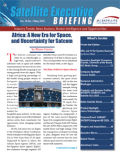
The May-June 2025 issue of the Satellite Executive Briefing is now available. Featuring:
Africa: A New Era for Space and Uncertainty for Satcom by Blaine Curcio
Five Ws and One H for System Success by Bruce Elbert
Administrative Blockages Puts Europe's Ability to Defend Itself at Risk by Dr. Robert Brüll
Better Satellite World: The Bright Side of Changing Diapers by Lou Zacharilla
Executive Spotlight: Interview with Francesco Cataldo, Chairman of the Board-iKO Media Group
Plus Products and Services Profiles SATExpo (CABSAT) and Satellite Asia 2025, Mergers and Acquisitions, Market Trends, Executive Moves, and many more. Click here to read or download the file
Gilat Satellite Networks Ltd. (NASDAQ: GILT, TASE: GILT), today reported its results for the first quarter, ended March 31, 2025. The company reported taht revenues Increased 21% Year-over-Year with Adjusted EBITDA of US$ 7.6 Million

MarketBrief Report on the Geospatial Market sponsored by Neo Space Group
Featuring:
Trends on the Geospatial Market by Elisabeth Tweedie
Interview with Eng. Abdulaziz Alfarraj, CEO-NSG Geospatial Services
To read or download the pdf of full report click here.