

Global Markets - Latest Developments

The November-December 2025 issue of the Satellite Executive Briefing is now available. Featuring:
Executive Roundtable on the Multi-Orbit Antenna Market by Bernardo Schneiderman
Reliability: You Don't Know What You've Got Till It's Gone by Bruce Elbert
The Emergence of Sovereign Constellations by Vivek Prasad
Cyberthreats in Your Backyard by Jason Bates
Plus Company and Product Spotilights, Market Trends and many more. Click here to read or download the file
Comtech Telecommunications Corp. (NASDAQ: CMTL)today reported financial results for its first quarter ended October 31, 2025.
Applied Aerospace and PCX Aerosystems jointly announced the merger of the two organizations, establishing a unified and transformational supplier of precision hardware and systems for aircraft, rotorcraft, satellites, launch vehicles and missile defense. The combined company will be known as Applied Aerospace & Defense. It leverages the capabilities of two well established industry leaders, each with proven heritage, delivering highly engineered solutions for military, commercial, and scientific applications.
The International Telecommunication Union (ITU) is p announced that the next Radiocommunication Assembly (RA-27) and World Radiocommunication Conference (WRC-27) will take place in Shanghai, China, from 11 October to 12 November 2027.
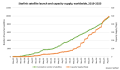
Non-GEO constellation players have transformed the satellite communication (satcom) industry in the past five years. Leading this transformation is Starlink, which has set new benchmarks in satellite deployment speed, capacity influx, and customer acquisition. Other players like Amazon’s Kuiper, Eutelsat’s OneWeb, Telesat’s Lightspeed and SES’s mPower continue to reinforce the viability and advantages of Non-GEO solutions. As nations increasingly recognize the benefits, such as scalable bandwidth and reduced cost per Mbps, there is a growing shift toward developing sovereign constellations. These national initiatives are driven by the urgent need for secure communications, digital autonomy, and strategic resilience in response to shifting geopolitical landscapes and rapid technological progress.
Gilat Satellite Networks Ltd. (NASDAQ: GILT, TASE: GILT today reported its results for the third quarter, ended September 30, 2025.
Comtech Telecommunications Corp. (NASDAQ: CMTL) today reported financial results for its fourth quarter and fiscal year ended July 31, 2025.
Kratos Defense & Security Solutions, Inc., a technology company in defense, national security, and global markets, announced today that it has signed a definitive agreement to acquire 100 percent of the ordinary shares of Orbit Technologies Ltd (ORBI.TA) for US$ 356.3 million, which is expected to be funded via cash on Kratos’ balance sheet.

Non-GEO constellation players have transformed the satellite communication (satcom) industry in the past five years. Leading this transformation is Starlink, which has set new benchmarks in satellite deployment speed, capacity influx, and customer acquisition. Other players like Amazon’s Kuiper, Eutelsat’s OneWeb, Telesat’s Lightspeed and SES’s mPower continue to reinforce the viability and advantages of Non-GEO solutions. As nations increasingly recognize the benefits, such as scalable bandwidth and reduced cost per Mbps, there is a growing shift toward developing sovereign constellations. These national initiatives are driven by the urgent need for secure communications, digital autonomy, and strategic resilience in response to shifting geopolitical landscapes and rapid technological progress.
Anyone who either purchases or provides telecommunications services understands the importance of reliability – the confidence that the service will always be there when it’s needed. The popular song from 1970, The Big Yellow Taxi, sung by Joni Mitchell, tells us how we’re surprised when what we thought we had isn’t there. I’ve experienced a fiber outage due to the construction of a hotel (not pink like in the song but it did have a parking lot); it was across the street from our satellite control center. My organization planned for 100% backup fiber from AT&T, composed of two underground cables to separate switching centers. A cable cut wasn’t supposed to happen because the local telco had their inspector on the construction site with the underground drawing. Unfortunately, that plan was inaccurate and a backhoe cut a cable. Unbeknownst to the seller of this service, the alternate route actually went over the same cable! A senior technical executive with MCI (now part of Verizon) once defined this as a backhoe fade: “It’s deep, and it’s long”. Loss of communication between the control center and the Tracking, Telemetry and Control (TT&C sites left eight GEO satellites on their own for a day, until we restored service using a temporary backhaul satellite link.